Wednesday, April 16, 2014

The Hungry Quebecois


I’m proud of my French heritage and I believe more people should feel the same way. Let me be clear: when I say people, I’m referring specifically to Anglos, Allophones and immigrants who live in Quebec; and by French Heritage, I’m referring to the art and honour of speaking French.
Because us Anglos are labeled as such, we intrinsically take an opposing position-labels have a way of doing that. The notion of opposition within society is always a political, religious, or territorial notion, but it no longer reflects our Provincial majority. It’s an ‘us and them’ mentality the world over, but it doesn’t have to be in Quebec; why? Because we are all French Canadian—Anglos and Allophones included.  And if the recent election is any indication that there might be a hint of goodness and foreword thinking in the majority of our 'home-grown' French Friends, then the English-speaking crowd needs to reciprocate, and the best way to do that is to embrace the French language and Culture. Speak French everywhere you go, cook-up some Quebecois grub once and a while, watch some French television, and most importantly, celebrate St Jean Baptist Day as a proud Quebecer.  I believe doing all these things will bring down the French/English divide, but it's also in our rights, as people who were born in Quebec, to be patriotic about the land from which we hail.  
Some of you will read this as a concession piece, like I’m suggesting you give in to your English or Ethnic ideal and identity; that is not the case, that’s an old and out-dated mentality ill-suited to new lands and fresh-start frontiers. You can embrace more than one identity; American’s do it all the time.  Pride in one’s land will only foster unity between those who live on that land, not because we need to be good neighbours, but because unity can only occur when the fence comes down.
It’s not the immigrant’s fault. The moment Canadian immigrants took that step off the proverbial boat into Quebec, a political and social axe of division swept down and made sure patriotism stayed in the old country. My grandparent’s early days in Quebec were steeped in racism. Strangers in a strange land who incurred a backlash rooted in fear and ignorance; two sentiments still evident in the now defunct Charter of Values. (Sentiments, I might add, that were felt by not only French Canadians, but Anglos alike as well.) I’m Quebec born and of Italian ancestry, but most of my paysans would defiantly exclaim themselves to be Italian, as in, “Me, I’m Italian”, but this is not true, for you my Belle Province dwelling, Italian brethren, are just as French Canadian as Josée Legault.  Your last name pays honour to your ancestry, it doesn't give you the right to mentally pretend you're a citizen in your grandparent's land.
We all need to take French patriotism into our own hands and mouths. We need to remove the two sides of the Quebec equation. Only with an awareness (and desire) that this Province belongs to all of us can we reach equality and disarm the separatist 'us V them' rhetoric. If you were born in Quebec, or are a Canadian citizen and make Quebec your home, then you are a French Canadian: You can be English speaking and still be a Proud French Canadian.  Embrace the culture, put your hands in the soil, speak French and above all, love The Montreal Canadiens! 

Politics aside, this is a food blog and politics and food are sometimes dinner companions. A good way to embrace your French Canadian heritage is to make a trip to a Cabane a Sucre a yearly pilgrimage. It’s a way to get in touch with your Quebec side by way of learning how the first French pilgrims worked the land and ingeniously harvested sap.  And the food at a Cabane a Sucre honours the frugal resourcefulness of our French ancestors, exactly like it does in every part of the world’s historical food story: feve au lards is to the Quebecois what polenta is to Italians. The two restaurants below are a great place to start.


Au Petit Poucet: 1030 Route 117, Val-David (Quebec) J0T 2N0. (819) 322 2246

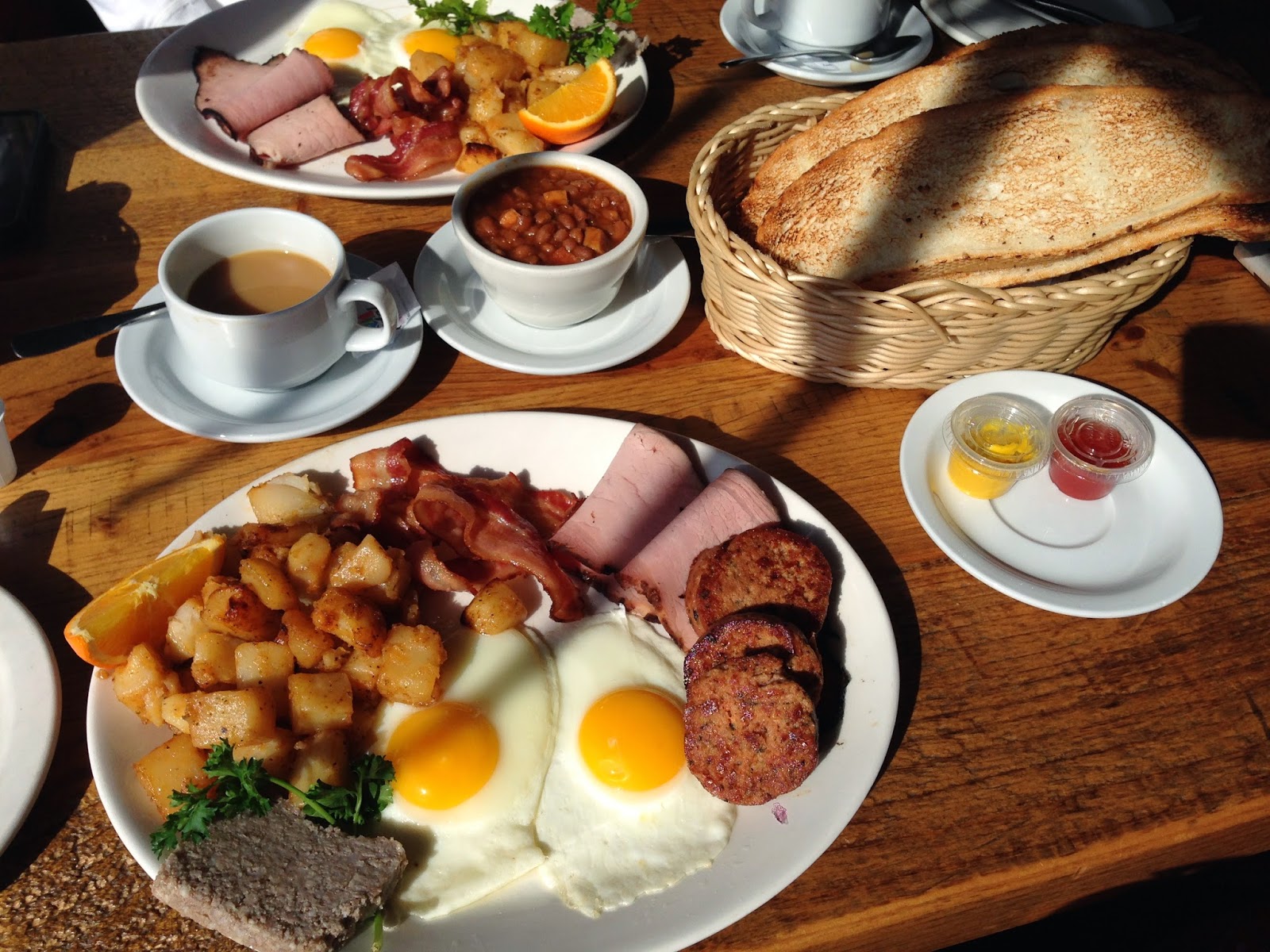
I love Au Petit Poucet; it's a place for those will big appetites and those not planning to eat the rest of the day.  It's only 45 minutes from Montreal and worth a breakfast run.
Fig,1, The pig says it all. Come hungry.


Fig.2. A fridge stocked with preserves and pies to go.

Fig.3. Quebec is home to the elusive Jackalope

Fig.4. A hearty breakfast not for the faint of heart.


Cabane a Sucre La Petite Cabane de la Cote: 5885, Rte Arthur-Sauve, Mirabel, Qc, J7N 2W4

La Petite Cabane de la Cote is a real, old fashion sugar shack: sticky floors, maple trees as far as the eyes can see, and the unmistakable smell of animal shit in the air, all within a dilapidated, wooden barn structure that shakes unnervingly in the wind. The tablecloths are plastic (as they should be) and the food is Pilgrim-French: pickled beets, chow chow, buckwheat pancakes, fried pork rinds, baked eggs, meat pies, and enough baked beans that will have you Googling every gastroenterologist in Quebec. C'est bon tabarnac!


Fig.5. Preserved food to start

Fig.5. Classic Pea Soup

Fig.6. Classic Baked beans. You keep eating and they'll keep bringing.

Fig.7. Fried pork rinds, or in French, Les orielles de Christ is essentially deep fried bacon fat.

Fig.8. Cook a lot of eggs in a cast iron pan in a hot oven and what you get is this: souffle-like scrabbled eggs.

Fig.9. This is un balle de grand-pere, which translates to, grandpa's ball. I've never tasted an old man's balls, but I doubt it's as sweet and delicious as this doughy ball of goodness.


5885, route Arthur-Sauvé

Mirabel, Qc
J7N 2W4
Réservation
(514) 990-2708
(450) 258-2467


Sunday, March 30, 2014

Spaghetti Con Salsa di Maiale Ubriaco.


Fig.1. A Hearty Pasta

Spaghetti Con Salsa di Maiale Ubriaco.

I haven’t posted on this blog in two months.  Cooking seems to have lost some of its spark for me. I no longer yearn for the smell of garlic or the sound of a sizzling pan.  Maybe it’s this eternal winter, maybe its age, maybe its life, maybe I’m just tired from all the chewing. But it’s not completely gone. I do have moments of culinary bliss that present, often, like a slap in the face: a perfect crispy chicken wing, a hot soft meatball, and, most recently, from a cassoulet I made for some friends.  
The times that I do experience culinary delight are the times I hear The Call of The Wild, and like the Alaskan Huskies in Jack London’s story, I howl and beckon to my laptop and my imagination: at times they come, at times they stay away.  Mostly of late, they stay away, or, in fairness, I keep them away.
This cold weather makes me want to braise stuff in red wine, lots of red wine, enough red wine that I have ample enough to get drunk with while my meat braises.  This recipe literally translates to: Spaghetti with drunken pig sauce. It’s good for two reasons: tastes great and it’s better not to get drunk alone. 

Spaghetti Con Salsa di Maiale Ubriaco
Spaghetti with pork braised in red wine sauce
Serves 4

This recipe works better when you space it out over two days. On the first day you simply braise the pork in wine for a couple of hours, and on the second day you just assemble the sauce and cook the pasta. It’s also an excuse to drink wine two days in a row.

Ingredients:
1 to 1 ½ lbs of pork. You can use a large pork loin, or, part of the pork shoulder.
1 bottle of a good full bodied red wine.
1 large onion, quartered
4 cloves of garlic, peeled and whole
1 can of whole plum tomatoes, crushed with your hands
3 anchovies
1 large red onion, diced
Chili flakes
Salt and pepper
500 g (1 pack) spaghetti

Directions:
Day one: Pour your self a glass of wine. Add some olive oil to a heavy bottom, medium pot.  Once your oil becomes hot, add the pork and sear it on both sides. Once your pork has obtained that golden color add the onion and garlic, empty the whole bottle of wine in the pot and bring to a simmer. Let the pork simmer, semi-covered, for about two hours. Once the wine has reduced by about ¾, remove from heat, cover the pot in plastic wrap and refrigerate.  Keep drinking wine, I hope you bought two bottles.
Day two: Remove the pork from the pan and remove any fat that has congealed on the surface of the pork or the wine reduction. Chop the pork and the onion and garlic in little pieces and add it back to the pot with the wine. Bring the wine reduction to a gentle simmer and add the crushed tomatoes, bring it back to a simmer.
At this point, bring a pot of salted water to a boil for your pasta. 
Add some olive oil to a large, non-stick pan set over medium high heat. Once the oil gets hot add the anchovies, the red onion and the chili flakes. (It’s a soffritto people, you need to remember and practice your basics: Soffritto-trito-battuto, revise them all. I like to break the anchovies up in the pan with my wooden spoon.) Once the onions are translucent, add the wine and pork mixture, stir well and season with salt and pepper.  Add your spaghetti to the pan with the pork mixture and mix well. Serve immediately with some freshly grated Parmesan cheese. (You should have more than enough sauce, but, if it appears a little dry, add some of the pasta water.)


Fig.2. Browning in olive oil

Fig.3. Getting the pork drunk.


Fig.4.Chop it all up


Fig.4. Get your soffritto on.

Fig.5. Add the drunken wine to the soffritto.


Fig.6.  Winter food.

Friday, January 24, 2014

Believing in Better Meat and a Better Me


Fig.1 Happy cattle.


Cynicism not only serve as a destructive force to humanity, it also provides an excellent shield, via circumstantial ad hominem, for those who would anoint with cynicism to hide behind.
At one point last week, funneled in a transitional share between social media users, a video surfed its way into the laptops, phones and tablets of millions of people. The video depicted the rampant abuse of pigs inside a Tyson industrial processing plant. The makers of the video addressed the disturbing revelations to retail giant, Wal-Mart, Tysons biggest client. I wont describe the video in this article, just Google it if youre curious. But, if curiosity is all you have then you just might be a cynic. If curiosity is all you have then you just might be bored. If curiosity is all you have, then, once youve watch the video, you wont be curious anymore; the proverbial itch will be scratched and therein lies the problem.
Watching from a computer screen, within the safe confines of our daily habits and routines, we become immune from the inner backlash that should erupt when curiosity meets anger. When I watched the video for the first time I was appalled-how could people, I wondered, be so cruel? I had lost faith in the goodness of humanity, a sentiment steeped in despair, and therefore, a sentiment that requires hope. Hope for me presented itself by way of self-fulfilling research: who breeds and butchers organic and humanly raised pork and where can I buy it?
Being a food writer, this was by no means the first time I bore witness to such a video. I first read about such centralized, mechanical, industrialized meat processing plants from the book, Fast Food Nation. Author, Eric Schlosser paints an apocalyptic scene filled with lakes of blood, riddled with heaps of carcasses, and filled with human cruelty.  But despite Schlossers descriptive scenes of carnage, a rational and merited argument can be made that such industrial meat plants are a necessity; how else can a populace of five hundred and thirty million plus meet their meat requirements? But our meat requirements are not being met, in fact, our meat requirements are being exceeded, our meat consumption is insatiable. According to a recent BBC health report “In the United States more than 75kg (165lbs) of meat is consumed per person each year. In Germany that figure is around 60kg. Huge amounts compared to per capita meat consumption rates of 38kg in China, and less than 20kg in Africa.” (In Canada, per capita meat consumption ranges from 38 to 50kg per person depending on which report you believe. Given our proximity to the U.S, I would lean toward the higher estimation of 50kg.) Also, according to the BBC report, over 70 billion animals are killed every year worldwide to meet our meat requirements, most of which are ground and pureed to make processed meat products, such as is found in frozen foods and fast food items. And meat consumption worldwide is going up, as Europeans and Asian countries adopt a more Western approach to daily food rituals.
I spoke to many people who saw the video, all were appalled-some below the threshold of curiosity, others, fuelled by anger, have transcended simply being curious to the point of proactive awareness.  
Being proactively aware is a powerful sensation. If it's channeled correctly it can fill you with the realization that you hold power, and that power to choose can sway a business practice and change, what you once perceived of as a permanent landscape, into a temporary one. For while the cynic has a general lack of faith and hope in the world, what they really have, is a lack of faith in themselves-they are cynics to their spirits, doubters to their abilities, skeptics to their power.

And so, to the cynic in which the status quo tastes just fine I would say stop hiding. Ignorance can be bliss but the cost is getting too high. There are costs to cheap meat that register beyond the final grocery tab: high processing costs, gas emissions from long distance transportation, soil pollution from industrial abattoirs, feeding all these animals, and, worst of all, the detriment to our heath and health care system all have costs and repercussions that will be on our grandchildrens shoulders. The cost disparity between what we pay for food and what its really costing us is as plain as day and as elusive as our indifference. Now, more than ever, Oscar Wilde was right, people today know the cost of everything and the value of nothing.

Moral and Organic edible meats available in the following places:
Boucherie Lawrence: 5237 St Laurent, Montreal. (Between St-Viateur and Faimount) 5142778880
Boucherie Ferme Saint-Vincent in the Jean Talon and Atwater Markets.
Les Fermes Valens: 79 York, Huntington, Qc, Canada, 450-264-4061

Wednesday, November 20, 2013

Simmering Bones


Fig.1. The late Marcella Hazan


Simmering Bones
 
Cook your Bones in a Soul Kitchen.
Close the page scented cookbook.
Feel the food,
Touch the sizzle.
Smell the animal's cries,
and don't blame the onion for that boil in your eyes.
Let no decorative plate ever taste as fine,
than that of the fruit's forbidden intent to preserve and keep us alive.
A celebrity pot who smiles and stirs for a stain of glitter,
Will never equal the grandmother whose soul rose, in time, between simmers.


Fig.1. Culinary manifesto of renaissance cook, Bartolomeo Scappi.

Fig.2. The death of Francois Vatel, cook to Louis the 14th.
 

Thursday, October 31, 2013

I Want to be a Quebec Pepper Smothered in Bacon


Local peppers can still be had. Look for Quebec peppers at the box-super-markets (not the corporeal ones that say Tabarnac, rather, the green and red vegetable variety-known in French as poivron) This recipe is simple and fast, just like this article. I should also mention that there's a lot of bacon in this dish-now I got your attention.

Pasta With Bacon And Peppers
Serves 4 to 6


Ingredients:
3 tbsp olive oil
6 Bell peppers, diced (any color will do, I like to mix red and green)
Half a pack of bacon, chopped (Buy the low sodium variety)
3/4 cup white wine (chicken stock will work too.)
Salt and pepper, to taste
Chili flakes, to taste
Freshly grated Parmesan cheese
450g to 500g Pasta, long or short it's up to you.


Directions:
Add the olive oil to a large, heavy bottom sauce pan set over medium heat.  Add the diced peppers to the pan, give the pan a shake.


Sprinkling the chopped bacon evenly over the  diced peppers-DO NOT STIR.


Cook for 8 to 10 minutes without stirring. (The lack of stirring action will allow the peppers to properly brown, while at the same time allowing for an even fond to form on the bottom of the pan; also, the heat will cause the bacon fat to drip in and around the diced peppers, which will confit the peppers.) Season with salt, pepper and chili flakes. At this point, start cooking the pasta. Your (salted) water should already be boiling, add the pasta to the water and cook until al dente.


After about 10 minutes of not stirring, give the ingredients a stir and continue to cook until bacon is golden but not crispy.  Add the wine or chicken stock, turn the heat to high and using a wooden spoon, scrape the caramelized brown bits (see picture above) that have formed on the bottom of the pan until dissolved and liquid is reduced by half, at this point, shut the heat off.  Add the cooked pasta to the pan and stir well.  Serve immediately with some freshly grated Parmesan.


Friday, October 25, 2013

Marcel Proust's Pastina


Fig.1. Pastina the way my mother made it. The pasta changed with her moods and the specials of the week but she always used a small pasta.

The longer you are disconnected from ancestry, the more you connect with a way of life that alienates oneself from the past. Food, however, is one of those marvelous vehicles that can help you reconnect with not only tradition, but with an emotional state of childhood bliss lost in the recesses of your adult mind: a Rosebud winter stew, a Proustian Madeleine, or in my case, a pastina soup made with chicken, carrots, celery, and of course, pasta.


Fig.2. The guy on your left is thinking about gnocchi. The framed guy on your right is thinking about his aunt's madeleines and tea. Ref-Portrait de Marcel Proust, Jacques-Emile Blanche 1892. Musee d'Orsay, Paris.

Marcel Proust, in his epic work, In Search of Lost Time (also published under, In Remembrance of Things Past, and originally in French as, A la Recherché du Tempe Perdu) addresses (among many other things) the notion of food and memories.  The narrator, in Volume one of Proust’s epic, is reminded of his past while eating a madeleine soaked in tea.  This madeleine triggered an event the narrator describes as, An Involuntary Memory, which is defined by Oxford as: a subcomponent of memory that occurs when cues encountered in everyday life evoke recollections of the past without conscious effort.
Based on this definition, an involuntary memory cannot be planned. Now here comes the conundricle (I just made this word up) paradox: If I suggest, like I often do, and by the very nature of this article, and indeed, the right existence of this blog, that you go and connect with your culinary past and cook something traditional, the experience will be voluntary, thereby evoking a Voluntary Memory; rather, what I want all of you to do is simply to be aware.  Awareness comes in the form of many guises, but the best pretext of all is the one that come unexpectedly. So the next time you’re eating something home-made, empty your mind of disconnecting thoughts and allow your attention to transcend into a netherworld of trapped memories. I don’t know how to do this, but according to Proust, it will happen on it’s own if you let it.
And another thing, if you’re a parent, pay attention to what foods you’re offering your child in moments of distress, these comforting foods are the very triggers your child will involuntarily experience 30 years from now when they themselves are assaulted by life’s grievances. Food that will reconnect your child to you long after they have lives of their own and become disconnected with you in the paternal sense.  It’s in your child’s best interest that they involuntarily recall something you made from the heart, rather than from any reactions that might derived from a Twinkie.

Pastina is soup derived from stock. The very word pastina amongst Italians connotes comfort.  It’s what our grandmothers and mothers made us when we were sick or throughout the cold winter months.  If I needed extra soothing, my mother would cut up hot dogs and add them to my pastina. Any stock will do.

Ingredients:
Chicken bones
4 chicken thighs
6 carrots
6 celery stalks
1 large onion
5 cloves garlic, whole
4 Bay leaves
Salt and pepper, to taste
Cooked pasta (use something small)

Directions:
Put all of your ingredients in a large stockpot and cover with water. Bring to a light boil and simmer for 3 to 4 hours. Make sure you skim the fat periodically. Let the stock cool overnight in the fridge. Remove any fat that has congealed on the surface and remove all of the ingredients from the stock.  Pass the stock through a sieve to remove any floating particles. (I don’t always do this. Floating particles do not bother me nor do I weigh the want or appearance of consommé upon my culinary shoulders.) Cut up the chicken, carrots, celery and onion, and discard the bay leaves, garlic and chicken bones. Add the pasta to the broth and what you’ve got is an Italian Pastina alla Nonna.

Fig.3. Watch Anton Ego have an Involuntary Memory. (I always cry when I watch this.)