Monday, January 28, 2013

Risotto Poutine, or, Risotto Avec Fromage Nouveau et Demi-Glace. Risotto Obsession Part 2 and Superbowl Snacks Part 1


Fig.1. Risotto Poutine-c'est bon en tabarnack!


If we look at the basic building blocks of a poutine as consisting of a sound starch, cheese and sauce, then there’s no reason why rice can’t be a suitable substitute for potato.  This abomination of a Quebec staple—which came to me one night whilst I soaked in a bubble bath—is surprisingly good.  It’s also much easier to make than most conventional risottos, given that it only contains four ingredients. 

Risotto is all about technique, and this risotto is no exception.  The secret behind a smooth, creamy risotto resides in constant motion: stirring the rice frequently while it cooks releases the velvety starch imbued within each and every grain, but, did you know that in Italy, the stirring doesn’t always end when the risotto is cooked? 
There is a cooking technique particular to risotto in Italy known as La Mantecatura.  A Mantecatura involves adding butter (or olive oil, or any fat for that matter) to your risotto after it has finished cooking and stirring it in vigorously, the aim of which is to release more starch (amylopectin) from the grain of rice.  If you preform a Mantecatura, use a smooth rubber spatula as I outlined in my last post. While a wooden spoon is the kitchen tool of choice when it comes to stirring, its rough surface and latent jagged exterior could damage the rice. Some Italian chefs execute La Mantecatura solely by flicking the pan with their wrists, a technique that sends a thin stream of risotto piercing through the air only to splash back down into a bath of velvety risotto, a technique that requires much practice.


Fig.2. Ingredients at the ready.

Risotto Poutine
Serves 4
The only questionable aspect about this risotto was the poutine sauce: too much of a good thing can have an adverse affect; such was the case with the poutine sauce in this recipe.  I made the first batch of risotto by using poutine sauce as my liquid from beginning to end; the result, like my mother, when used too much, it became overbearing.  For the second batch, I started with chicken stock, when the rice reached the half-cooked stage, I started adding poutine sauce, the result, as we say in the land of the poutine, modit qu'c'est bon! This poutine pairs very well with a Pepsi and a May West.

Ingredients:
4 cups chicken stock

1 ½ cups Carnaroli rice
2 cans St Hubert Poutine sauce, about 3 cups (feel free to use any poutine sauce you’d like. Next time I make this recipe, I plan on using a sauce from one of my favorite poutine dives such as Chez Ma Tante, La Patate Anjou, La Banquese, Burger Bar, Blackstrap bbq, KFC, etc.)
2 cups fresh cheese curds.

Fig.3. Stirring in the 'squeaky cheese'.

Directions:
In one medium pot, bring the chicken stock to a simmer, in another medium size pot, bring the poutine sauce to a simmer.
Set a non-stick pan over medium heat, add the rice and cook for about 3 to 4 minutes while stirring. (this toasts the grains of rice, which imparts a nutty end flavor to your risotto.) Add two ladles of chicken stock and stir until liquid is almost all absorbed, repeat with another two ladleful’s of chicken stock.  At this point, taste the risotto. If the rice is still hard, add another two ladles of stock, if the rice is firm (soft on the outside and hard on the inside) when bitten then you can start adding the poutine sauce.  Add some poutine sauce and stir until most of the sauce is absorbed (take care in making sure the rice does not stick, which it is prone to do, especially when the liquid begins to be absorbed.) Repeat until the rice is al dente. When the rice is cooked, add the cheese and stir it in until it melts. Add a bit more sauce if desired. Serve immediately.  Estie c’est bon!

A note on cheese curds:
If you live in Quebec, Vermont, New York, or Wisconsin, you are probably familiar with cheese curds (sometimes called squeaky cheese in Canada.  The cheese squeaks against the teeth because of air trapped in the cheese.  If the cheese isn’t fresh, it won’t squeak because the air trapped in the curds escapes, usually within 24 hours.)  Cheese curds are a very fresh, mild cheddar. When making Cheddar, the curds are collected, formed, and then aged. 
Proper cheese curds for a poutine should be small and kept at room temperature.  If the curds are too big they will not melt properly (unless you prefer the cheese in your poutine to be al dente as well) In Quebec, you can purchase cheese curds designated for poutine, it’s indicated on the package.  You can also simply chop up any mammoth sized cheese curds.

Friday, January 18, 2013

The Risotto Obsession, Part 1


Fig.1. Risi e Pisi
I want to start my culinary year by obsessing over something.  Obsession gets a bad rap, it’s a great way to promote focus and dedication while making sure one holds on to fixations that nurture one’s faults and insecurities.  In the past I’ve obsessed over such things as pasta, bread, pizza, tortiere, oh, and who can forget the 2003 bolito misto fiasco that saw the consumption of countless sheep, swine and beef innards. So what to obsess over in 2013? After conferring with my neurosis I’ve decided that risotto would be apt to loose sleep over.  Why obsess over risotto? It’s simple: because it’s bliss when made correctly, and tragic when made without love, and it all starts with a grain of rice.

Fig.2. Carnaroli is harvested in Vercelli in Northern Italy, located in the Piedmonte region.  It's a medium grain rice with more starch than found in regular Arborio rice.


Fig.3. Italian Cinema made risotto appetising in more ways than one.   

Short grain rice is a must when making a classic, Italian risotto. Long grain rice won’t work and Uncle Ben’s should only be used after you die.  The difference between short grain and long grain rice is about starch content: the general rule of thumb is that long grain rice emits less starch and medium and short grain rice emit more, it’s the starch that makes a risotto creamy, but only up to a point, to make a creamy risotto, you need to follow certain rules.
Making risotto is all about patience and technique, however, I’ve made risotto many times in the past with both of the above-mentioned traits only to fail miserably with a resulting bowl of clumpy, stucco-like globs of starch. I usually turn to America’s Test Kitchen when I want to quell any food issues I have, but this time, I needed to find someone equally fanatical about their stove-top conquests, someone consumed with whatever recipe might lay before him: Alton Brown.
Alton’s approach to risotto is both traditional and scientific, he dissects the grain of rice and outlines what proteins and amino acids make up a grain of medium and short grain rice.  Brown also contends that technique when making risotto is key, he advises to plan ahead and have all your ingredients ready.  He also writes about the importance of stirring. While most people stir with a wooden spoon, Brown and I agree that a rubber spatula when making risotto is better, although for different reasons. Brown uses a rubber spatula out of habit and because it’s better suited at preventing the rice from sticking to the bottom of the pan, I like to use a rubber spatula because it’s gentler on the rice. The rough exterior of a wooden spoon can damage the outer walls of the rice, which can cause the rice to break apart. (in case you’re curious, the two main molecules that make up the inner part of a grain of rice are amylose and amylopectin. These two glucose molecules are pure starch: long grain rice has a higher percentage of amylose; amylose will hold its shape, which is why long grain rice stays fluffy and independent. Medium and short grain rice have higher concentrations of amylopectin, which will leech out of the rice grain when cooked and agitated, thereby filling the surrounding liquid the rice is cooked in with starch.)
Like any obsession, the best place to start is with a manic approach and tenacious insecurity, so we begin with a simple Italian classic that’s not simple at all.

Risi e Pisi e Pancetta
Risotto with peas and bacon
Serves 4
Risotto is not a make ahead dish, it needs to be served immediately! Make sure whom ever your cooking for is seated at the table with fork in hand, or better yet, obsess by yourself first, impress later. Also, use an Italian risotto, and by that I mean rice grown in Italy. Many of the Arborio packages with Italian sounding names contain grains from other countries, they might not be bad, but rice from Italy, in my opinion, works best for risotto because it keeps it’s ‘grain integrity’ longer, it's creamier, and tastes better. I especially like Carnaroli rice.  Risi e Pisi is a classic Italian risotto.

Fig.4. Hot and ready, like me.

Ingredients:
6 cups chicken stock
Olive oil
1 medium onion. diced
½ cup pancetta, diced in small cubes (if you don’t have pancetta, use bacon)
1 ½ cups Italian Rice (such as Carnaroli or  Vialone Nano)
½ cup white wine
1 cup of peas
3 Tblsp butter
Grated Pamigiano Reggiano
Freshly ground black pepper.

Directions:
Place the chicken stock in a pot and bring to a simmer.
Add your olive oil to a pan set over medium heat.  Once the oil gets hot, add the onion and pancetta and cook until onion is translucent, about 8 minutes.  Add the rice to the pan and stir with a rubber spatula for about 3 minutes. (What you’re doing here is toasting the rice, this really adds depth to the flavor.)  Add the wine to the rice and cook until it’s reduced completely. (the rice drinks up the wine, it drinks it all up!) This is where you start adding the chicken stock.  Add 2 or 3 ladles of stock to the rice, stir the rice until most of the stock is absorbed, repeat this step and continue until the risotto is al dente, don't stop stirring, stirring is essential for a creamy risotto. Don’t let the rice get too mushy, but it shouldn’t be hard either. (if the peas are frozen, add them when adding your stock for the second time, if the peas are fresh or canned, add them at the end.)  When the rice is ready, remove it from the heat, add the butter and grated Parmigiano, and cover for 2 minutes. (This lets the rice come together) Serve immediately.

A Note About North and South.
Northern Italians prefer their risotto creamier, resembling a porridge or thick soup; Italians in the South, on the other hand, prefer it slightly drier. (like you see in the above recipe.)  If you want your risotto to be very creamy, add a bit more broth right at the end, stir well and serve immediately, skip the butter and don’t cover the risotto.

Wednesday, December 5, 2012

Toqué! Learning From The Best


Fig.1. A great looking book, both outside and within the covers.

Norman Laprise is the father of Quebec cuisine.  There, it’s been declared—no illusions or allusions to anything otherwise.  Can I back up this declaration? I can’t but Norman Laprise can:  His career as a chef began in the kitchens of Quebec City, where he chopped and sautéed his way toward Montreal and landed in Citrus in 1989, where Laprise was head chef. It didn’t take long for him to get noticed, four years later he opened Toqué! With Christine Lamarche; the rest is history. (Google it if you don’t believe me)
It is my opinion that Norman Laprise is this province’s premier food pioneer: It was Laprise who obsessed over freshness long before it was trendy to do so; as a result, he looked for food in nearby rivers, lakes and cattle fields, as freshness and proximity go hand in hand.  He has a connection with food and the earth, a connection that can only come from being raised as a farm boy, a connection that compels him to use his vegetables stem to seeds and his animals nose to tail.  He fuses local ingredients together, such as scallops and pine needles, opening up new flavor possibilities while simultaneously reshaping the local, food landscape. He’s committed to using the whole ingredient, a tomato in Laprise’s hands is squeezed, prodded, analyzed and respected until it gives up every ounce of flavor, scent, and taste it contains. The best part of all this is that Laprise does it for the food, as well as for himself: no fanfare and no vanity, just a respect for food and the desire to educate who he feeds; he also happens to be one of the nicest people I’ve ever met.


Fig.2. Toqué!'s take on a bacon lettuce and tomato. This BTL is a perfect example of Laprise's  approach: simple and elegant with an emphasis on freshness.

Motivated by food and sharing, Laprise began to work on a cookbook nearly three years ago, along with his business partner, Christine Lamarche, and Toqué!’s chef de cuisine, Charles-Antoine Crete.  This cookbook is a veritable gold mine of knowledge that will show you how to turn food into gold.  But if you read this book properly, it’s not just your food that will turn to gold, but your attitude toward food as well.
Buy yourself this cookbook for Christmas, you will not be disappointed: the stories are entertaining and illuminating, and the photographs are beautiful. And while the recipes might appear complicated at first glance, this complexity stems only from the visual beauty off of each recipe.  Read through the recipe and you’ll discover that Laprise’s approach to food is not one of complexity, but of honesty: take a few, simple ingredients, make sure they’re the best and freshest ingredients you can buy, grow or somehow procure, and love them until they’re cooked with style.
The Toqué! cookbook is available both in English and in French and can be found in most major book stores, as well as on Amazon.

Fig.3. Prosciutto and strawberries.


Friday, November 23, 2012

Zuppa Di Lenticchie e Manzo


Fig.1. Just before adding water. 


If you’ve been a faithful follower of THI for more than one winter, you’ll no doubt be aware that nesting is a part of my pre-winter routine. While cold air might involuntarily compel some people to stack their pantry shelves with Campbell’s canned soup, the cold air triggers the need in me to nest by way of homemade soup. (By the way, did you know that Campbell’s discovered several years back that they could increase soup sales by linking their radio advertising spots with cold weather. They developed an algorithmic computer program that tells different radio stations across the Continent when to run their soup ads; if you’re hearing a Campbell’s soup ad on the radio, there’s a good chance you’ll need an umbrella and a parka.)
Cold, frigid air demands a hot and hearty soup and nothing does hearty like lentils and beef. Protein is the key word here; one bowl is usually enough to keep you satisfied for hours. I’m getting tired of saying this, but this soup does taste better the next day.

Fig.2. Zen And The Art of Mis-en-Place

Zuppa di Lenticchie e Manzo  
Beef and Lentil Soup
Serves: a small army

When I make soup like this, I make enough to freeze. Knowing that I have several containers of soup nestled in the freezer nurtures my inner nester.  If meat isn’t your thing, just omit the beef, at your own peril.

Ingredients:
4 to 5 tbsp olive oil
about 700g Stewing beef, cut into large pieces (I like to use the blade, but feel free to use pre-cut cubes of stewing beef. Some stewing beef sold in supermarkets isn't the greatest so go to a butcher instead and tell them you want a beef cut that will shred easily when braised or boiled.)
1 large onion, chopped
4 large parsnips, chopped
4 to 5 large carrots, chopped
4 stalks of celery, chopped
4 to 5 medium potatoes, diced
Water
4 cups chicken stock
1 can (28oz) whole plum tomatoes
4 bay leaves
1 ½ cups lentil (I use Easton Green, they take very well to being boiled and won't go mushy)
Salt and Pepper

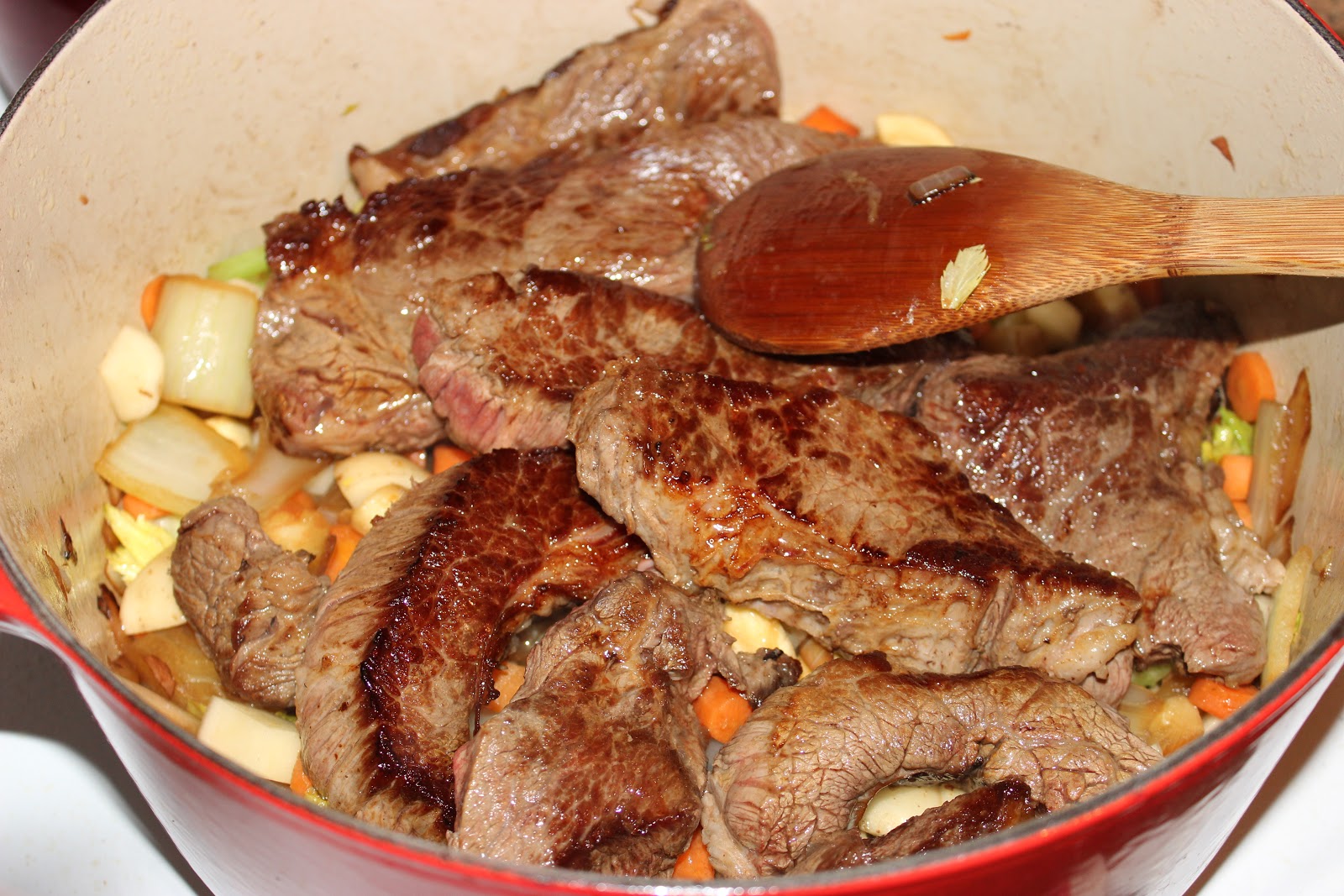
Fig.3. Browning the meat and getting a proper fond on the bottom of your pot is crucial to any soup or stew.  The trick is patience and low to medium heat.  Never set burners too high.

Directions:
Add olive oil to a large Dutch oven or heavy bottom pot and set over medium heat.  When your oil begins to shimmer and slightly smoke, add some meat to the pot (do not over-crowd). Brown meat on both sides and set aside.  Add some more olive oil to the pot if necessary and add the onion, parsnips, carrots, celery and potatoes. Cook and stir well for about 8 minutes. Place the meat back into the pot and add just enough water to barely cover the meat.  With a wooden spoon, scrape the bottom of your pot making sure you dislodge all the fond stuck to the bottom (this is all flavor baby!)  Add the chicken stock, the can of tomatoes and the bay leaves and bring to a gentle boil.  Add the lentils and simmer until lentils are done, carrots are tender, and beef breaks apart. Season with salt and pepper.