Friday, September 19, 2014

Eating Sine Qua None


Fig.1. All of the above ingredients are farm sourced. When cooking with such ingredients, your finished dish will sing songs of sublime taste. Such ingredients should be Sine qua none with life.


Sine qua none refers to an ‘indispensable and essential action, condition, or ingredient.’ (Wikipedia) It’s a Latin legal term that has tied its assertion alongside many of life’s doctrines. I first read the words Sine qua none in a cookbook. The author used the term to explain that, while it’s up to the reader what ingredient they ultimately use, the end result is indispensably linked to the quality of ingredients used.  One can see evidence of this when eating in the county sides of France, Italy or Greece: Farm and hill sourced ingredients will cause the final dish to rise significantly up the taste echelon when compared to the same dish made within the walls of a city. And while many of the ingredients we buy carry markings of ‘local’ and ‘organic’ and ‘free range’, it’s best to remember that the finest, freshest, and best tasting of ingredients have no packaging at all; the only markings on the garlic you grow yourself is dirt. But like it or leave it, the vast majority of us who live in the city but long for a taste of the country have to avoid food-cynicism and find a way to cope. So, the question becomes, how does one live in a city and eat and cook sine qua none? The answer can be found in travel and sourcing.
There is one constant truth with regard to every major city the world over: they are surrounded by farms. Some of these farms are large-scale, industrial farms and some are small, family run; go to the latter. If 
you live in Montreal, you don't have to travel far. Laval has some great farms, most of which can be found on www.saveurdelaval.com  
A little further away than Laval, Vermont is a bastion of good ingredients. Vermont’s abundance of small farms, co-op farm programs, and food shops makes this American state an ideal place to source worthy ingredients.  Another noble trait that makes Vermont a territory filled with Sine qua none ingredients is their attitude towards food: eating local is not a theory in Vermont, it’s a practice. Any worthwhile restaurant in Vermont creates their menus with local ingredients front and centre.

For those who can't travel, sourcing involves knowing where your food comes. Your best bet is a farmer's market, but, ask questions. Buy local and eat foods that are in season is a tired sentence for most food writers worth a damn, but I'll keep writing and repeating it until I don't believe it anymore. 

The cookbook in which I read the words sine qua none, in case you were wondering, was in Jacques Pepin’s, Complete Techniques—an indispensable and essential cookbook if ever there was one. Pepin's mindset is one shared by all of the great gastronomes that have pondered the philosophy of food: Jean Anthelme Brillat-Savarin, James Beard, M.L.K Fisher and George Auguste Escoffier all agreed that only optimal ingredients should ever be used when cooking. 
There is, however, one essential need Pepin forgot to mention when it comes to food and eating. We would do well to remember that it’s not just our ingredients that should be sine qua none with what and how we eat, but hunger as well. For without hunger’s genuine state, nothing will taste as it should.


Fig.2. Farmer's Market in Woodstock Vermont.


Fig.3. A mascot cow from Sugarbush Farms in Vermont. Sugarbush is a great place to get Vermont Cheddar,  smoked cheese, and blue cheese.


Fig..4.  Moving to the country, gonna eat me a lot of peaches. 


Saturday, May 24, 2014

Zen And The Art of BBQ Maintenance


If one ever needed evidence that my father loved his barbecue above all other manly vices, then only a visual of the man cleaning his grill was evidence enough of that.
In early spring, my father baptised the change in season by spreading charcoal dust and rust over the lawn, a powder he claimed made good fertilizer; my stepmother didn’t agree.
It was on a Sunday in the Spring of 1999 that my father told me to get out of my pyjamas and help him, I was 13 years old. (I remember being surprised that he noticed me. When my father took to a task he focused solely on what he was doing, his gaze never wandering astray. This time he was distracted, this time, I distracted him.)
When I reached my father’s side he was hunched over scraping metal, the green grass over where he worked an industrial orange and black.
“These flame plates need to be scrapped clean. You see all of the shit stuck on there? That’s grease and fat. If it stays there it’ll catch on fire and you get flare-ups that will burn your meat. So get a metal brush and some scouring pads and scrape em hard. It’s the same with life kid, as the years cook you, your heart and your soul get filled with crap. You get a bad mark on a test, teacher yells at you, some kid makes fun of ya, or if your girl dumps you, you need to scrape that shit off yourself-sometimes once a month, sometimes every morning.”
My father told me this without once looking up at me, he scraped through it all. He continued. “As for the grills, it’s best not to clean em too much. Just a simple scrape with your wire brush is enough. The more you use your grills the more seasoned they become, you know what seasoned means son?”
This time he looked at me, and something in his eyes told me it was better not to lie to him, so I nodded no.
“Seasoned means that all of the oil and grease from the food makes your grills non-stick. The more you use your grill, the less your food will stick to the grill, and trust me kid, that’s a good thing. It happens to people too the older they get. The more bullshit life throws at you, the harder you get, the less that bullshit sticks to you. You gotta learn not to carry all of the worry, stress and dead weight life will pile on you, let it slide off of ya kid, it ain’t yours to own, it’s yours to get rid of, you hear what I’m saying to ya?”
My father reached out, grabbed me by the chin, and positioned my face so my eyes met his. “It ain’t yours to own boy.”
“I hear you Pop.”
My father looked at me for a few seconds, contemplating my soul for any dead weight. He let go of me and continued.
“Next thing you want to check is your propane regulator. The regulator is this U.F.O looking apparatus that attaches to your propane tank. The propane regulator regulates the flow of propane gas from the tank to your grill. Sometimes the regulator gets stuck and the gas doesn’t flow enough, that’s when you get that low flame that won’t heat worth a damn. All you got to do is unscrew the hose from the propane tank and open all the valves on your BBQ, turn all the dials to max. Let them be for a couple of minutes. This empties any gas stuck inside your burners. Now, reconnect the propane tank, close all your BBQ valves to off, and very slowly open the propane tank until completely opened. Turn one of your dials to max and ignite. That should do the trick. If your flame is still low, try all that again, if it doesn’t work, change your regulator.  There’s another lesson for you son. Like this here regulator, you need to control what you let in: Anger, fear, hate, you need to regulate those emotions. Don’t let too much of that in you, and if it does get in, get rid of it as fast as you can.”
My father didn’t talk much to me after that. He began to put his BBQ back together as if I wasn’t just part of his world, as if we hadn’t just shared a moment. My father had become good at regulating what he let in, and the emotions associated with me was one of the things in his life he regulated best.  I reckon that had something to do with my Birthmother.
My biological mother used to say that I was good in her womb. That nine months wasn’t enough. She accused my father of taking me out to soon. “It ain’t enough time for no baby. That’s why they come out of their Mama’s belly with the chord. The chord feeds that baby but it’s also a way for that child to get back in.” She used to say over and over, sometimes just to me as if it were our own sworn secret. The last words she told me just before she was committed were, “you didn’t climb back in, you didn’t climb back in.”
That was many years ago and I’m a father of my own now. I see now how my father tried to shield me from any ownership handed to me by my mother’s last words. But his over-protectiveness blurred many lines for me. I’ll never know if my father simply wanted to show me how to maintain a BBQ, or if he was afraid I would go through life without knowing how to do something.


(The title of this short story inspired by Zen And The Art of Motorcycle Maintenance, by Robert M Pirsig. A book I read when I was 14 and which has stayed with me ever since.)

Monday, April 28, 2014

Pasta A GoGo: The Poet And His Pasta


On my last visit to Pasta A GoGo I was overcome with sentiment upon tasting Robert Bergola's Pappardelle. I’ve never had finer pasta, and as such, I was inspired to compose this Ode. It stems from a reflection educed by taste and flavor, and how simple food at its finest can soupçon the sublime.

Ode to pasta

(In Praise of Robert Bergola and what he creates.)

And with an empty stomach and full eyes do I,
See where it sits upon thine white porcelain surface,
A plate clad in gluten you have become,
Made by one called ‘The pasta guru' by some.

It begins as Eden intended, most humble.
But enter human ingenuity, a force like lightning asunder. 
Behold two ingredients in the form of liquid and powder most unadorned,
two elements joined by chance, or perhaps by way of Keat’s extempore.
One strewn from Prairie stalks, the other from prancing hens,
Joined together to form a doughy mass, a yellow, soft, rounded gem.

Palms white, back and forth action, 
Forcing a merger between flora and fowl.
Rest my sweet ball of dough ye shall rest,
For soon your serenity will give way to pressing, cutting and boiling;
A doomed fate most necessary; the price paid for our toiling. 

Lo, the water boils, what shape shall Robert bestow upon you?
Bring forth the instruments of your craft,
whose wondrous beauty your mechanics will make true.
O my most mighty of glutinous men,
from whom all noodles beyond the mark of delicious do transcend.
create and serve your pasta for me and mine,
in wait we rejoice and sing your skills atop Olympus’ shrine,
so that we might sing aloud of your accolades,
before our eyes give way to hunger’s shade.

But before I have a gogo at this feast within my sight,
Tis only fair, it seems, to reflect in that fleeting moment of delight.
For from the celestial second my fork spins its first silky noodle,
to the ominous end when utensil rests on mine empty plate,
is but a flash in a cook’s pan, and so… my end shall wait.

So let me stare at your beauty and dance with delight,
Let me anticipate with scent your taste, as is my sovereign right.
But most of all, as I pay homage to the skills of one with what I write,
It is Robert’s gift that gives so we may all taste Ataraxia’s light. 


Wednesday, April 16, 2014

The Hungry Quebecois


I’m proud of my French heritage and I believe more people should feel the same way. Let me be clear: when I say people, I’m referring specifically to Anglos, Allophones and immigrants who live in Quebec; and by French Heritage, I’m referring to the art and honour of speaking French.
Because us Anglos are labeled as such, we intrinsically take an opposing position-labels have a way of doing that. The notion of opposition within society is always a political, religious, or territorial notion, but it no longer reflects our Provincial majority. It’s an ‘us and them’ mentality the world over, but it doesn’t have to be in Quebec; why? Because we are all French Canadian—Anglos and Allophones included.  And if the recent election is any indication that there might be a hint of goodness and foreword thinking in the majority of our 'home-grown' French Friends, then the English-speaking crowd needs to reciprocate, and the best way to do that is to embrace the French language and Culture. Speak French everywhere you go, cook-up some Quebecois grub once and a while, watch some French television, and most importantly, celebrate St Jean Baptist Day as a proud Quebecer.  I believe doing all these things will bring down the French/English divide, but it's also in our rights, as people who were born in Quebec, to be patriotic about the land from which we hail.  
Some of you will read this as a concession piece, like I’m suggesting you give in to your English or Ethnic ideal and identity; that is not the case, that’s an old and out-dated mentality ill-suited to new lands and fresh-start frontiers. You can embrace more than one identity; American’s do it all the time.  Pride in one’s land will only foster unity between those who live on that land, not because we need to be good neighbours, but because unity can only occur when the fence comes down.
It’s not the immigrant’s fault. The moment Canadian immigrants took that step off the proverbial boat into Quebec, a political and social axe of division swept down and made sure patriotism stayed in the old country. My grandparent’s early days in Quebec were steeped in racism. Strangers in a strange land who incurred a backlash rooted in fear and ignorance; two sentiments still evident in the now defunct Charter of Values. (Sentiments, I might add, that were felt by not only French Canadians, but Anglos alike as well.) I’m Quebec born and of Italian ancestry, but most of my paysans would defiantly exclaim themselves to be Italian, as in, “Me, I’m Italian”, but this is not true, for you my Belle Province dwelling, Italian brethren, are just as French Canadian as Josée Legault.  Your last name pays honour to your ancestry, it doesn't give you the right to mentally pretend you're a citizen in your grandparent's land.
We all need to take French patriotism into our own hands and mouths. We need to remove the two sides of the Quebec equation. Only with an awareness (and desire) that this Province belongs to all of us can we reach equality and disarm the separatist 'us V them' rhetoric. If you were born in Quebec, or are a Canadian citizen and make Quebec your home, then you are a French Canadian: You can be English speaking and still be a Proud French Canadian.  Embrace the culture, put your hands in the soil, speak French and above all, love The Montreal Canadiens! 

Politics aside, this is a food blog and politics and food are sometimes dinner companions. A good way to embrace your French Canadian heritage is to make a trip to a Cabane a Sucre a yearly pilgrimage. It’s a way to get in touch with your Quebec side by way of learning how the first French pilgrims worked the land and ingeniously harvested sap.  And the food at a Cabane a Sucre honours the frugal resourcefulness of our French ancestors, exactly like it does in every part of the world’s historical food story: feve au lards is to the Quebecois what polenta is to Italians. The two restaurants below are a great place to start.


Au Petit Poucet: 1030 Route 117, Val-David (Quebec) J0T 2N0. (819) 322 2246

I love Au Petit Poucet; it's a place for those will big appetites and those not planning to eat the rest of the day.  It's only 45 minutes from Montreal and worth a breakfast run.
Fig,1, The pig says it all. Come hungry.


Fig.2. A fridge stocked with preserves and pies to go.

Fig.3. Quebec is home to the elusive Jackalope

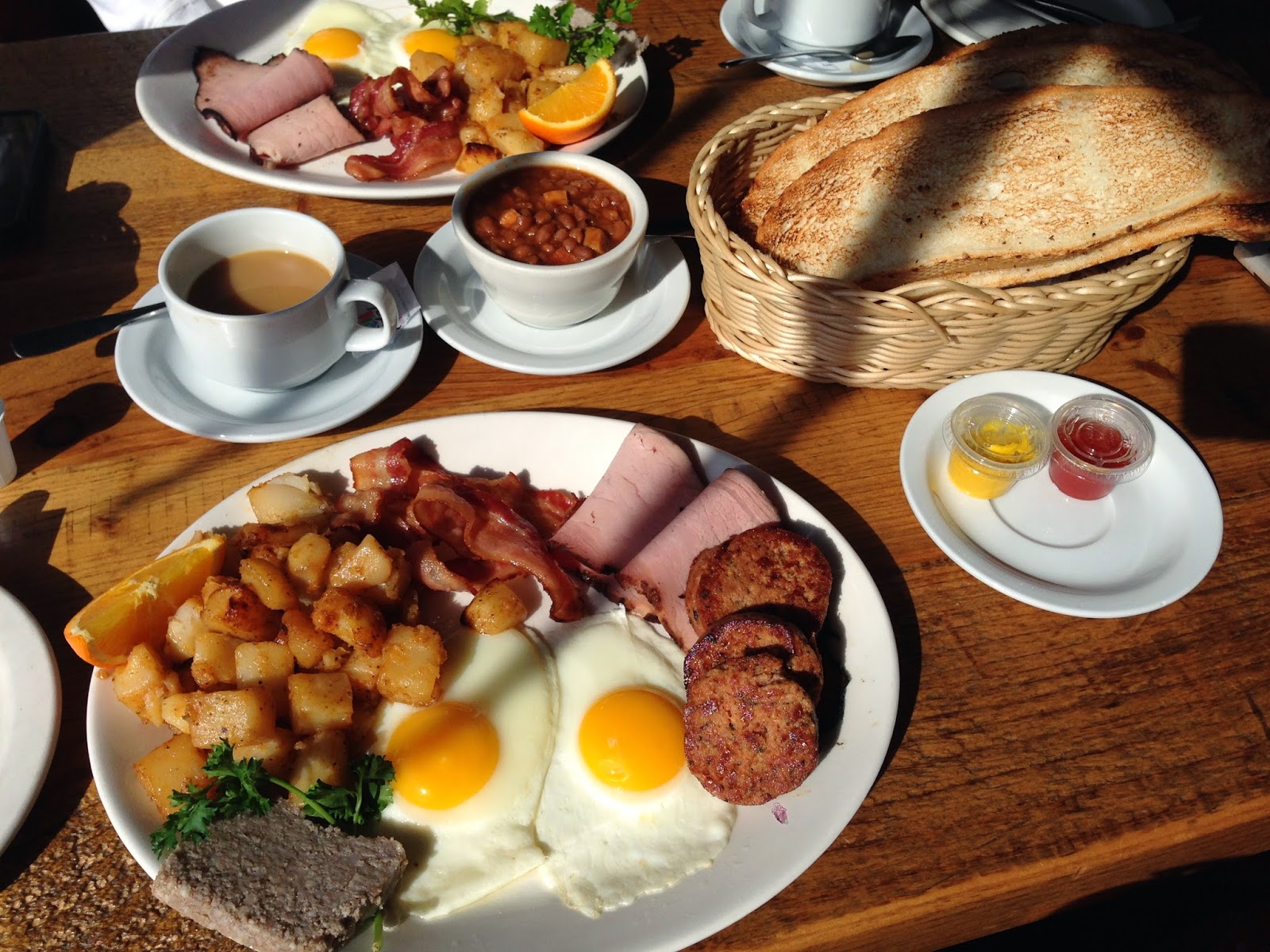
Fig.4. A hearty breakfast not for the faint of heart.


Cabane a Sucre La Petite Cabane de la Cote: 5885, Rte Arthur-Sauve, Mirabel, Qc, J7N 2W4

La Petite Cabane de la Cote is a real, old fashion sugar shack: sticky floors, maple trees as far as the eyes can see, and the unmistakable smell of animal shit in the air, all within a dilapidated, wooden barn structure that shakes unnervingly in the wind. The tablecloths are plastic (as they should be) and the food is Pilgrim-French: pickled beets, chow chow, buckwheat pancakes, fried pork rinds, baked eggs, meat pies, and enough baked beans that will have you Googling every gastroenterologist in Quebec. C'est bon tabarnac!


Fig.5. Preserved food to start

Fig.5. Classic Pea Soup

Fig.6. Classic Baked beans. You keep eating and they'll keep bringing.

Fig.7. Fried pork rinds, or in French, Les orielles de Christ is essentially deep fried bacon fat.

Fig.8. Cook a lot of eggs in a cast iron pan in a hot oven and what you get is this: souffle-like scrabbled eggs.

Fig.9. This is un balle de grand-pere, which translates to, grandpa's ball. I've never tasted an old man's balls, but I doubt it's as sweet and delicious as this doughy ball of goodness.


5885, route Arthur-Sauvé

Mirabel, Qc
J7N 2W4
Réservation
(514) 990-2708
(450) 258-2467


Sunday, March 30, 2014

Spaghetti Con Salsa di Maiale Ubriaco.


Fig.1. A Hearty Pasta

Spaghetti Con Salsa di Maiale Ubriaco.

I haven’t posted on this blog in two months.  Cooking seems to have lost some of its spark for me. I no longer yearn for the smell of garlic or the sound of a sizzling pan.  Maybe it’s this eternal winter, maybe its age, maybe its life, maybe I’m just tired from all the chewing. But it’s not completely gone. I do have moments of culinary bliss that present, often, like a slap in the face: a perfect crispy chicken wing, a hot soft meatball, and, most recently, from a cassoulet I made for some friends.  
The times that I do experience culinary delight are the times I hear The Call of The Wild, and like the Alaskan Huskies in Jack London’s story, I howl and beckon to my laptop and my imagination: at times they come, at times they stay away.  Mostly of late, they stay away, or, in fairness, I keep them away.
This cold weather makes me want to braise stuff in red wine, lots of red wine, enough red wine that I have ample enough to get drunk with while my meat braises.  This recipe literally translates to: Spaghetti with drunken pig sauce. It’s good for two reasons: tastes great and it’s better not to get drunk alone. 

Spaghetti Con Salsa di Maiale Ubriaco
Spaghetti with pork braised in red wine sauce
Serves 4

This recipe works better when you space it out over two days. On the first day you simply braise the pork in wine for a couple of hours, and on the second day you just assemble the sauce and cook the pasta. It’s also an excuse to drink wine two days in a row.

Ingredients:
1 to 1 ½ lbs of pork. You can use a large pork loin, or, part of the pork shoulder.
1 bottle of a good full bodied red wine.
1 large onion, quartered
4 cloves of garlic, peeled and whole
1 can of whole plum tomatoes, crushed with your hands
3 anchovies
1 large red onion, diced
Chili flakes
Salt and pepper
500 g (1 pack) spaghetti

Directions:
Day one: Pour your self a glass of wine. Add some olive oil to a heavy bottom, medium pot.  Once your oil becomes hot, add the pork and sear it on both sides. Once your pork has obtained that golden color add the onion and garlic, empty the whole bottle of wine in the pot and bring to a simmer. Let the pork simmer, semi-covered, for about two hours. Once the wine has reduced by about ¾, remove from heat, cover the pot in plastic wrap and refrigerate.  Keep drinking wine, I hope you bought two bottles.
Day two: Remove the pork from the pan and remove any fat that has congealed on the surface of the pork or the wine reduction. Chop the pork and the onion and garlic in little pieces and add it back to the pot with the wine. Bring the wine reduction to a gentle simmer and add the crushed tomatoes, bring it back to a simmer.
At this point, bring a pot of salted water to a boil for your pasta. 
Add some olive oil to a large, non-stick pan set over medium high heat. Once the oil gets hot add the anchovies, the red onion and the chili flakes. (It’s a soffritto people, you need to remember and practice your basics: Soffritto-trito-battuto, revise them all. I like to break the anchovies up in the pan with my wooden spoon.) Once the onions are translucent, add the wine and pork mixture, stir well and season with salt and pepper.  Add your spaghetti to the pan with the pork mixture and mix well. Serve immediately with some freshly grated Parmesan cheese. (You should have more than enough sauce, but, if it appears a little dry, add some of the pasta water.)


Fig.2. Browning in olive oil

Fig.3. Getting the pork drunk.


Fig.4.Chop it all up


Fig.4. Get your soffritto on.

Fig.5. Add the drunken wine to the soffritto.


Fig.6.  Winter food.