Thursday, October 29, 2009

Shortie Bars-Let The Christmas Baking Begin

Fig.1. Make sure you enjoy your efforts with a proper espresso before you give these squares away.

It’s that time of year again in The Hungry Italian household. There’s 30lbs of butter in the freezer (I’m not exaggerating), and 30lbs of flour resting next to 30 lbs of sugar in the garage. My wife, Lisa, along with her mother and sister, bake about 30 different types of goodies: Assorted shortbreads, decadent bars and tempting cookies get stuffed into metal tins which are then given out to friends, family and freeloaders alike.
This year I’ve convinced my wife to share some of the recipes, (which is a relief as some of you are aware that baking just isn’t my thing) as well as take pictures of her creations. I hope you give some of them a try; despite the initial investment, you do save money in the long term (just think about all the little presents you hand out: bus driver, teachers, hockey coach, mailman—you get the idea). They’re also great to have handy, just pull them out when company comes over or bring them to your next Christmas party instead of that usual bottle of wine.

Shortie Bars
These squares are basically nothing more than shortbreads with a chocolate surface; this recipe was adapted from the back of an old Chipit bag.
Makes 4 to 5 dozen 1” squares

Ingredients:
1 ½ cups salted butter
¾ cup granulated sugar
3 cups unbleached all-purpose flour
1 to 1 1/2 cups semi-sweet chocolate chips (You can add more if you want a thicker chocolate topping)

Directions:
Preheat your oven to 350F degrees. Cream butter and sugar until light and fluffy; gradually blend in flour until mixed thoroughly (mixture will be crumbly). Pat your dough evenly into a greased 9x13-inch pan. Bake at 350F for 20 to 25 minutes—or until lightly brown. Remove from the oven and immediately sprinkle the chocolate chips evenly over the surface. Let the chocolate completely soften, then spread evenly. Let the chocolate set to a consistency where it’s easy to cut without cracking, cut into squares, then let set properly in the fridge. Freeze until needed.


Fig.2. The "ends", as we refer to them, are pieces cut along the sides of the pan which can't really be used because they are not straight and are too crumbly. Fortunately for my son and I, they taste just as good as the squares.

Friday, October 23, 2009

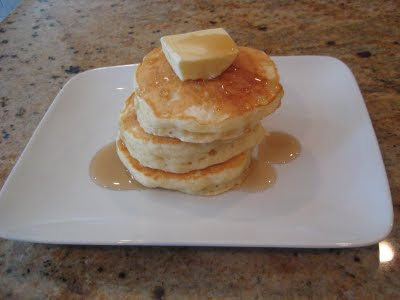
Flippin' Fat Pancakes


Fig.1. Big, light, moist and fluffy.

Our Canada magazine is having a pancake contest. If you have an old favorite or family pancake recipe send it in, there are $5000.00 worth of prizes to be won, courtesy of T-Fal. Go to http://www.ourcanada.ca/ for all the details. The deadline to enter is November 20th, we'll be narrowing it down to 10 recipes, which will be tested, photographed and posted online. The winner will be chosen by the Ourcanada community members-- all you need to do to become a member is visit the web-site and register.
Pancakes are one of the oldest foodstuffs in culinary history. They’ve existed in one form or another since man discovered that mixing water with various ground, whole grains, beans, or rice formed a paste that held its shape.
Today, in North America, we tend to associate pancakes as breakfast fare, but in many parts of the world they are still considered dinner: The French crepe and the Italian crespelle are rolled with such savory fillings ranging from cheese to seafood (although I’ve known the occasional Italian, myself included, who sometime like to smear their crepes with Nutella.) In The Netherlands, a pannenkoeken is a giant, egg-laden pancake that can be stuffed with basically anything the Dutch can think of. In Russia, they have the blini (a personal favorite), which are often served with a dollop of caviar. In Vietnam there’s the crispy and savory Banh xeo, which I usually order with BBQ pork and shrimp.
I could go on and on; every country in the world has their own pancake, instead, holding to the spirit of the contest (which of course I'm not allowed to enter) here’s my favorite breakfast pancake recipe, which I’ve adapted from the gang at America’s Test Kitchen.

Milk and Yogurt Pancakes


The original recipe from, America’s Test Kitchen, calls for buttermilk instead of milk—the buttermilk works equally well but gives it more tang. They also use sour cream, which I’ve replaced with unsweetened, plain yogurt. The yogurt make for a lighter pancake while at the same time imparts the tanginess lent to it by the missing buttermilk.

Ingredients:

2 cups unbleached all-purpose flour
2 tablespoons sugar
½ teaspoon salt
1 teaspoon baking powder
½ teaspoon baking soda
2 cups whole milk
¼ cup+2 tablespoons plain, unsweetened yogurt
2 eggs
3 tablespoons of unsalted butter, melted and cooled slightly
1-2 teaspoons vegetable oil

Directions:

1. Adjust oven rack to middle position and heat oven to 200 degrees. Spray wire rack set inside baking sheet with nonstick cooking spray; place in oven. Whisk flour, sugar, salt, baking powder, and baking soda together in medium bowl. In second medium bowl, whisk together milk, yogurt, eggs, and melted butter. Make well in center of dry ingredients and pour in wet ingredients; gently stir until just combined (batter should remain lumpy with few streaks of flour). Do not over mix. (Over mixing begins the gluten process which will result in tougher pancakes) Allow batter to sit 10 minutes before cooking. Your batter should be quite thick.

2. Heat 1 teaspoon of oil in 12-inch nonstick skillet over medium heat until shimmering. Using paper towels, carefully wipe out oil, leaving thin film of oil on bottom and sides of pan. (Whipping the excess oil from your pan ensures that your pancakes obtain an even, full, golden brown finish, it’s also based on the assumption that you’re not completely incompetent in the kitchen.) Using ¼ cup measure, portion batter into pan in 4 places. Cook until edges are set, first side is golden brown, and bubbles on surface are just beginning to break, 2 to 3 minutes. Using thin, wide spatula, flip pancakes and continue to cook until second side is golden brown, 1 to 2 minutes longer. Serve pancakes immediately, or transfer to wire rack in preheated oven. Repeat with remaining batter, using remaining oil as necessary. I also suggest you try the pancakes before you slather them with butter and maple syrup, you might be very surprised at how well they hold their own.


Fig.2. Fig and tangerine pancakes; place the fruit into the pancake after you drop it into the pan, then flip carefully. A thin flexible spatula is essential for pancakes such as these.

Fig.3. Chocolate chip pancakes, simply add some chips to your batter.


Tuesday, October 13, 2009

Tomato Sauce Redux


Fig.1. For proper canning techniques go to http://www.canningpantry.com/index.html

I’m starting to think that my obsession with tomatoes is unhealthy. I’ve written so much about them, both for the magazine and for this site, that I was sure there was nothing else to say: I was wrong. What keeps driving me is the never-ending (and unattainable) quest for the perfect tomato sauce: I’ve dissected them, peeled them, removed seeds, removed jelly, and passed them all through a myriad of grinders, presses and sieves. Sometimes the sauce turned out, other times, not so much. So after all this time and trial where am I now—I’m back to the tomato, untouched and unaltered.


Fig.2. Cut the tomatoes into manageable pieces, removing only the stem and any bruises or blemishes.


According to a recent study in, The Journal of Agriculture and Food Chemistry, tomato seeds and the surrounding jelly are packed with glutamic acid, a naturally occurring flavour enhancer also known as umami. The skin of the tomato we now know contains Lycopene; a powerful antioxidant. That’s why this year I’ve decided to keep it simple. I’m canning my tomatoes whole as nature intended. When I need to make sauce I simply put the preserved tomatoes in a blender and puree until all of the seeds and skins liquefy. I then make a soffrito of onions and garlic, and bring the sauce to a gentle simmer for a couple of hours.
In case you’re wondering, I got the tomatoes at the Birri Brothers kiosk in the Jean Talon market, which still abounds with beautiful harvest vegetables. I especially want to thank Joe and Mr. Birri for all of your great advice throughout the year (and Joe, the bell peppers were incredible).


Fig.3. Bring the tomato pieces to a rolling boil and skim off any tomato-scum which rises to the surface.


Fig.4. Put some fresh basil in your sterilized jars and fill with the boiling sauce. If your jars and your sauce are hot enough your jars should seal. It's very important to verify that each jar has properly sealed. If after 5 to 6 hours a jar has not sealed place the jar in a water bath and bring to a boil.

Saturday, September 26, 2009

Basi, Not Your Typical Italian Restaurant


My first thought upon seeing Basi was that yet again someone would try to make this well situated spot work. Located next to the Jean-Talon Market, this local sees a lot of traffic in the morning and afternoon, but much less at night, and, even less during the cold season.
The menu reveals traditional Italian fare, albeit with a modern and innovative touch, but food that any competent, home cook might conclude could be made at home-they would be wrong.
The menu at Basi is evident of a cook who has come full circle; absent is the multi-layered, copious ingredient laden, over thought creations, and in its place, a menu which reveals how truly difficult it is to make simple, fresh food work properly.
Two things stood out during my first dining experience at Basi. We were with some friends who had already eaten there, they had ordered the fried zucchini appetizers during their first visit and were eager for us to try them. Alas, this time around the menu revealed no fried zucchini. When my friend expressed his disappointment, the waiter, who instead of uttering “sorry, we don’t have any tonight” said “let me see what I can do.” He came back 2 minutes later and told us that someone was running over to the market to get some zucchini. Now, let me just say that in this lazy, indifferent “can’t be bothered” world where drooling, slack-jawed yokels stare at you with glazed eyes until you’re forced to give up it’s nice to see some hustle and a drive to please the customer. I don’t know about you, but the effort makes the food taste better—it must be the love.
The second thing to grab my attention was the fazzoletti. Aside from tasting great, my attention was captured by some small, green, unrecognizable herb that graced the top of the pasta. Turns out it was a seaweed called salicorne. Salicorne is found in sea marches, and like most seaweeds, is somewhat salty, but used correctly it serves to enhance the dishes other savors.
My first instinct about this location was that if I had the Jean-Talon market on my footstep I would use it with reckless abandon and that is exactly what Mercuri does. "If you can salt something naturally it's a bonus." was his response when I asked why salicorne. There are indeed many bonuses to be had dining at Basi: a deconstructed menu, a farmer's market at your doorstep and a passionate chef in the kitchen.


Fig.1. Fazzoletti, referred to as handkerchiefs in North America, can be stuffed with just about anything.


Fazzoletti di Ricotta and Butternut Squash with Butter, Sage and Salicorne
Makes 12 to 15 fazzoletti

Ingredients:

15 fresh lasagna sheets (available by the kilo at all fresh pasta shops)

Filling:

2 cups pureed butternut squash
950g ricotta (Mercuri makes his own, when using the store bought make sure it's not too watery. If it is, drain it in a fine sieve or a cheesecloth in the fridge overnight.)
1 egg
100g grated Grana padano cheese
50g pureed salicorne
nutmeg
salt and pepper


Sauce:
Unsalted butter
fresh sage
chopped raw salicorne
white wine
chicken stock
fresh parsley


Directions:

Boil the sheets of pasta in salted water until tender, transfer to an ice bath, then place on a dry tablecloth to dry.
In a large mixing bowl, mash the butternut squash, ricotta, egg, cheese, pureed salicorne, nutmeg, salt and pepper and mix well.
Using a spoon, place 2 tbsp of cheese mixture into the center of the pasta square, fold the edges of the pasta over to form a square. At this point, the fazzoletti can be frozen for future use or reserved in the fridge.
Just before serving, heat a pan over medium heat with 4 tbsp of unsalted butter, 4 sage leaves and 1 tbsp of chopped salicorne. Place 4 fazzoletti in the pan (do not overcrowd the pan) and begin to spoon the butter over the pasta as soon as it melts. When butter begins to turn golden brown, add some wine and let it reduce, about 2 minutes. Add some chicken stock to loosen the sauce and continue spooning over the fazzoletti as it cooks, another 2 minutes. Sprinkle with some fresh, chopped parsley and serve.


Salicorne is available at Chez Louis--514-277-4670- in the Jean Talon Market until November.

Basi: 77 ave Shamrock (corner Casgrain) 514-750-0790.

Tuesday, September 8, 2009

Eat your Maine from a basket.


Fig.1. Swimming in a sea of beige. Clockwise from left: Clam chowder served in a bread bowl, fried scallops, fried clams and fried haddock and chips. All from Bob's Clam Hut.

I’m a sucker for food in a basket. It comes with the expectation of having to eat with your fingers and the absence of pretension. My recent trip to Maine was packed with such unpretentious and delicious basket food. Also in abundance was some marvellous New England style Americana which came in the form of roadside stands and signs.


Fig.2. Out of all the fried clams I consumed, Bob's Clam Hut in Kittery was the best. The place was full of men working on their gout as they waited for their wives who were busy in the numerous, surrounding outlet stores.


Fig.3. US Route 1 through Maine is adorned with great antique stores and signs such as the one above. Lobster in The Rough was recommended to us by some locals. It has no address and is only opened during peak season. As the name suggests, tourists and locals alike eat on outdoor picnic tables surrounded by trees and then get drunk around an opened air bar. Add some oyster shots and a CCR tribute band and a good time is had by all--except for the lobsters of course.


Every food writer knows it’s not so much the food as it is the experience. Ocean-side eating is a perfect example of this: Eating a Lobster in Montreal can be a great experience, but eating one on the beach, feet in the sand while listening to and smelling the surf pound the shore can be sublime. There are many such experiences to be had in Maine, especially as you drive along US Route 1 from Kittery to Kennebunk.


Fig.4. A short walk from the beach, Fox's Lobster House,on York Beach, is situated on Nubble Point next to the Nubble Lighthouse.


Fig.5. A lobster roll and a bowl of clam chowder from Fox's. I don't get the allure of the lobster roll, as for the clam chowder, the best ones are an hour's drive south in Boston.


Fig.6. Steamed clams from Barnacle Billy's in Perckin's Cove. It come with drawn butter and some water to wash off any sand still stuck to the clam. The restaurant was a bit of a tourist trap but the food was surprisingly good, especially the fried scallops.


Fig.7. The only way, it seems, to get color in your diet in Maine is to eat lobster. I couldn't find a vegetable anywhere. (OK, maybe I wasn't looking in the right place...or looking at all for that matter.) This beautiful specimen was consumed at, Lobster in The Rough. Served with some drawn butter, it was sweet, juicy, and delicious. A great example of proper, honest food.


Bob's Clam Hut, 315 US Route 1, Kittery 207-439-4233 http://www.bobsclamhut.com/


Barnacle Billy's, Shore road, Perkin's Cove, 1-800-866-5575 http://www.barnbilly.com/


Fox's Lobster House, Nubble Point, York Beach 207-363-2643 http://www.foxslobster.com/


Lobster in The Rough, somewhere in York off of Route 1 in the deep woods.

Sunday, August 30, 2009

Getting Those Taste Buds Back in Shape


While I agree with the wisdom of Homer Simpson that you don’t make friends with salad I would have to maintain that there are seasons where a salad can be a revelation. Farmer’ Markets are currently teeming with fresh produce that could convert any vegetable hater. Experimenting with salads is also a great way to de-sensitize your taste buds.
Years of processed, over flavored food have made most of us oblivious too what proper food should really taste like. Over the years, ours pallets have been bombarded with over-seasoned foods-foods processed with an abundance of sugar, fat and salt—so much so that we now come to expect that everything should taste like a bag of Doritos.
In his very detailed book, The End of Overeating, Dr David Kessler examines how our brains not only function with regard to what he refers to as “hyper-palatable foods” but also how our thought process has evolved in this brave new food world. According to Kessler, most of us have become “conditioned, hyper-eaters”; our brains, Kessler contends, have been re-wired to seek out food that keeps fueling our reward system.
Autumn is always a happy time for me. The harvest brings with it a humbling awareness; a conscious wakefulness to the fact that everything we need can be provided to us by the land and the farmers who work them. If we truly open our eyes to this knowledge the next time we pick up that bag of frozen vegetables maybe you’ll see it under a different light.


Fig.2. This time of the year my salads have as much Heirloom tomatoes
that I can fit in the bowl.

I'm officially on the tomato hunt, let me know of any interesting tomato varieties out there and where I can get them--my sauce depends on it.

Monday, July 27, 2009

Summer Annuals Good Enough Eat


Fig.1. If you find flowers this beautiful, leave them whole

Zucchini flowers blossom just as the little fruits begin to take shape. The female blossoms are the ones which hold the small emerging zucchini or “marrow”, the male flowers derive solely from the stem or stalk of the plant. The male flower is smaller than the female but tastes the same.
Foodies are used to seeing them fried, but there are plenty of other ways to enjoy these very seasonal marvels. They can be sautéed and served as a side, or as a simple pasta sauce “in bianco”. They can be incorporated into an omelette or even in risotto; and go very well when mixed with onions, mushrooms and any and all herbs currently overtaking your garden. In Mexico they inventively use zucchini blossoms in soups, tacos and quesadillas.
My Grandfather always protested giving me any zucchini blossoms because he felt it stunted the zucchini’s growth; fortunately, my Mother and Grandmother always found a way to obtain some. The preferred method of cooking them was to chop them up, mix in batter and fry them in oil.
These days I buy my zucchini blossoms from the Birri Brothers in the Jean Talon Market. Get there early or call ahead and ask Joe or Frank to put some aside for you.

Fried Zucchini Flowers Stuffed With Ricotta

Ingredients:
Serves 4 to 5 as appetizers.

1 cup of all-purpose flour
1 tablespoon of olive oil
5 tablespoons of white wine
1 egg, whisked
¾ cup warm water
1 1/2 cups of ricotta (you might need more or less depending on the size of the flowers.)
2 tablespoons grated parmesan
3 anchovies, chopped (optional)
12 zucchini flowers, cleaned and dry
Salt and pepper
Vegetable oil, for frying

Directions:
Combine the flour, olive oil, wine and egg in a bowl. Add the water a little at a time and mix. Stop adding the water when you get a smooth and runny batter, let the batter rest for 1 hour.
Combine the ricotta, parmesan, anchovies and salt and pepper in a bowl and mix. Using a spoon, fill the flower with the cheese pressing the petals gently together when full so they stick to the cheese and stay closed. Dip the flowers in the batter and fry in oil (make sure your oil is 360 degrees) until golden brown. Drain on paper towels, sprinkle with salt and eat them warm.

Fig.2. Make sure the flowers are properly stuffed, and,
when dipped in the batter let any excess batter drain
back into the bowl.


Note: These can also be made without the ricotta, either chopped up or left whole, just add some parmesan to the batter.


Fig.3. These are best warm, sprinkle with salt and enjoy.